CISA Adds SimpleHelp Authentication Bypass Flaw to Known Exploited Vulnerabilities Catalog
TL;DR
If you’re running SimpleHelp, stop reading and go check your logs. Right now.
On June 29, 2026, CISA dropped a hammer on the industry, officially adding a nasty authentication bypass flaw in SimpleHelp’s remote monitoring and management (RMM) software to its Known Exploited Vulnerabilities (KEV) catalog. This isn't just another theoretical bug found by a bored researcher in a lab. Tracked as CVE-2026-48558, this vulnerability is currently being weaponized in the wild. Attackers are using it to waltz into environments, swipe credentials, and drop payloads without breaking a sweat.
Because the threat is active and the potential for damage is massive, CISA isn’t messing around. Federal agencies are under the gun to patch this by July 2, 2026, per Binding Operational Directive (BOD) 26-04. If you’re in the private sector, you might not have a federal mandate breathing down your neck, but the reality is the same: your window to patch is closing fast.
The Anatomy of the Breach: CVE-2026-48558
The root of the problem lies in SimpleHelp’s OpenID Connect (OIDC) implementation. Specifically, it’s a failure to properly verify cryptographic signatures—classified as CWE-347.
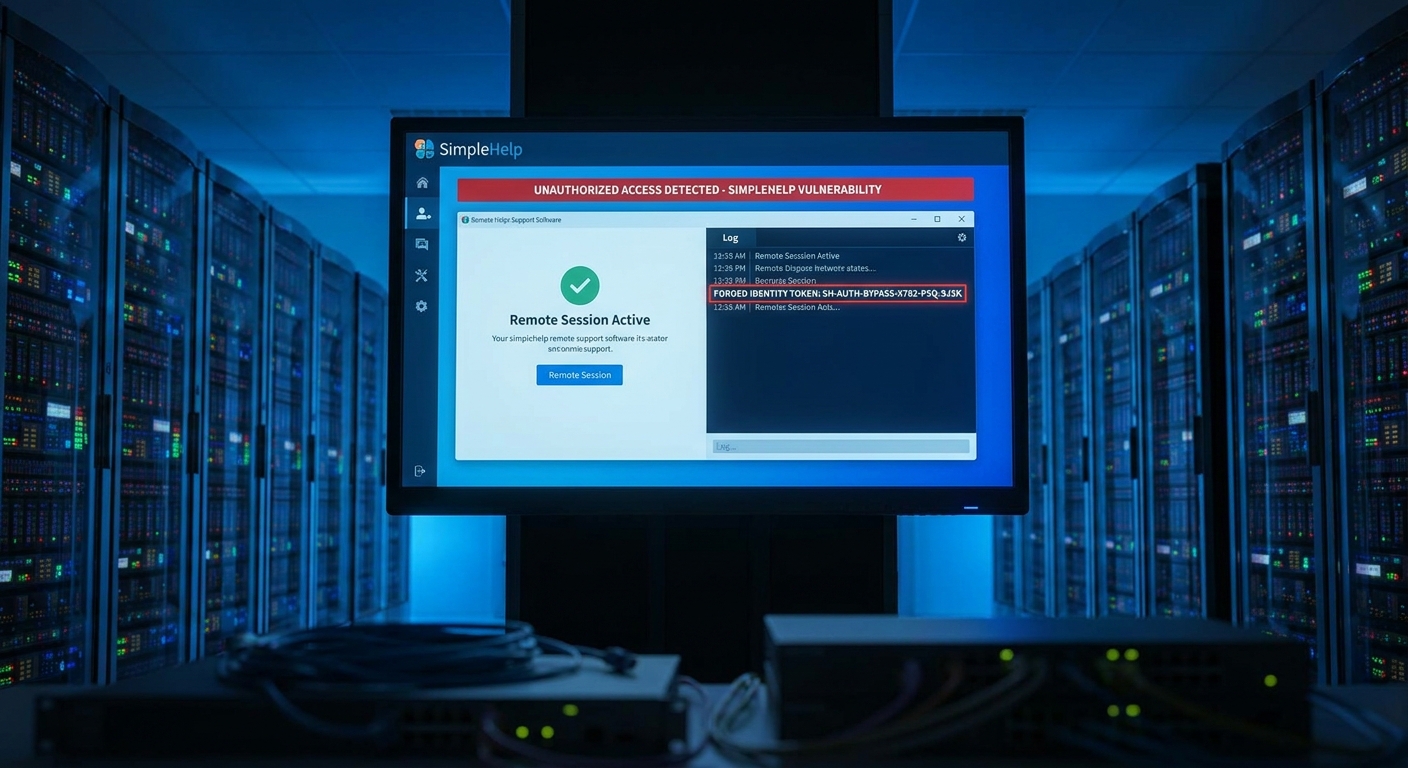
Think of OIDC as the digital handshake that confirms you are who you say you are. In this case, the handshake is broken. Because the software fails to check the signature properly, an attacker can simply forge an identity token. It’s the digital equivalent of walking into a high-security facility with a fake badge that the front desk doesn't bother to scan.
Once that fake token is accepted, the attacker gains technician-level access to the RMM console. And here is the kicker: because this bypass happens at the authentication layer, it often sidesteps multi-factor authentication (MFA) entirely. Once they’re in, they’re effectively the admin. They can manage remote endpoints, harvest whatever secrets are sitting in your system, and push malware to every machine under your management.
As Arctic Wolf pointed out in their technical breakdown, this is a major escalation. When you let an attacker masquerade as a legitimate technician, they don't just get a foothold—they get the keys to the kingdom. They can move laterally, hide in plain sight, and maintain persistence until they’ve drained the environment of everything valuable.
The Compliance Clock
CISA’s inclusion of this flaw in the KEV catalog is the industry’s version of a five-alarm fire. If you’re managing an RMM deployment, you need to treat this as a top-tier priority.
| Attribute | Detail |
|---|---|
| CVE Identifier | CVE-2026-48558 |
| Vulnerability Type | OIDC Authentication Bypass (CWE-347) |
| Affected Software | SimpleHelp RMM |
| CISA KEV Addition Date | June 29, 2026 |
| Remediation Deadline | July 2, 2026 |
If you’re wondering where to start, here is your checklist:
- Patch Immediately: Get your SimpleHelp instances updated to the latest vendor release. The fix for that signature verification issue is in there. Don't wait.
- Audit Your Logs: Go back through your authentication history. Look for anything that looks weird—unusual login times, strange IP addresses, or token activity that doesn't align with your technician schedules. If you’ve been compromised, the logs are likely where you’ll find the breadcrumbs.
- Lock Down Access: Why is your RMM console exposed to the open internet? If it doesn't absolutely have to be, pull it back. Put it behind a VPN or a secure gateway so only your authorized team can reach the management interface.
- Watch for Post-Exploitation: Assume the worst. Monitor your endpoints for unauthorized script execution or weird lateral movement. If an attacker has already been in, they might have left a backdoor behind.
The Bigger Picture
The fact that federal agencies have a July 2 deadline isn't just about patching software; it’s about verifying that the house is clean. BOD 26-04 requires these agencies to prove that no rogue identity tokens were generated or used while the vulnerability was live.
For the rest of us, the lesson is clear: RMM tools are the "holy grail" for threat actors. They are designed to provide deep, administrative control over remote machines. When you compromise an RMM tool, you aren't just compromising one server—you’re compromising every single machine that server manages. It is a force multiplier for attackers.
We’ve seen this movie before. Sophisticated threat groups love targeting the trust mechanisms in support software. They turn your own management utilities against you, transforming a tool meant to help you fix problems into a vector for total system compromise.
As the dust settles on CVE-2026-48558, the goal is simple: close the gap before someone walks through it. If you haven't audited your SimpleHelp deployment yet, do it today. Check for signs of forgery, verify your access logs, and make sure your incident response plan isn't just a document gathering dust. In the world of cybersecurity, the difference between a minor incident and a total catastrophe is usually just a matter of how fast you move when the warning light starts flashing. Stay vigilant, keep your systems tight, and keep an eye on the KEV catalog—it’s the best early-warning system we’ve got.