WatchGuard Issues Third Critical IKEv2 Patch in Ten Months as Legacy Firebox Devices Remain Exposed
TL;DR
WatchGuard Technologies has just dropped another urgent security patch, and frankly, it’s starting to feel like a recurring nightmare. We’re looking at a critical pre-authentication remote code execution (RCE) vulnerability—CVE-2026-13368—targeting their Firebox firewall appliances. If you’re keeping score, this is the third time in just ten months that their IKEv2 VPN daemon has sprung a serious leak. It’s a bad look for a platform that’s supposed to be the gatekeeper of your network’s perimeter.
The vulnerability, which hits a CVSS 4.0 score of 9.2, is a classic use-after-free memory corruption error. In plain English? It’s a race condition triggered during the LDAP authentication process of the Mobile User VPN when IKEv2 is in play. Because this is categorized under CWE-416, an unauthenticated attacker can swoop in and potentially run whatever code they want on your appliance with full system privileges. It’s the digital equivalent of leaving your front door unlocked and the keys in the ignition.
Technical Scope and Affected Versions
The fallout from this flaw depends heavily on which branch of Fireware OS your gear is running. While WatchGuard has scrambled to patch their current hardware, the sheer frequency of these IKEv2 vulnerabilities is raising some uncomfortable questions about the security posture of older, legacy equipment. Security researchers have been tracking this trend for a while now, noting that the IKEv2 implementation is becoming a favorite target for exploitation—a point driven home by the earlier CVE-2025-14733.
If you’re running a supported version, you need to get the latest Fireware OS update installed yesterday. For the full technical breakdown and deployment instructions, check out the official WatchGuard security advisory.
| Fireware OS Version | Status |
|---|---|
| 2026.2.1 | Patched |
| 12.12.1 | Patched |
| 12.5.x (T15/T35) | Unpatched |
| 11.x | End-of-Life |
Legacy Hardware Exposure: The "Forgotten" Devices
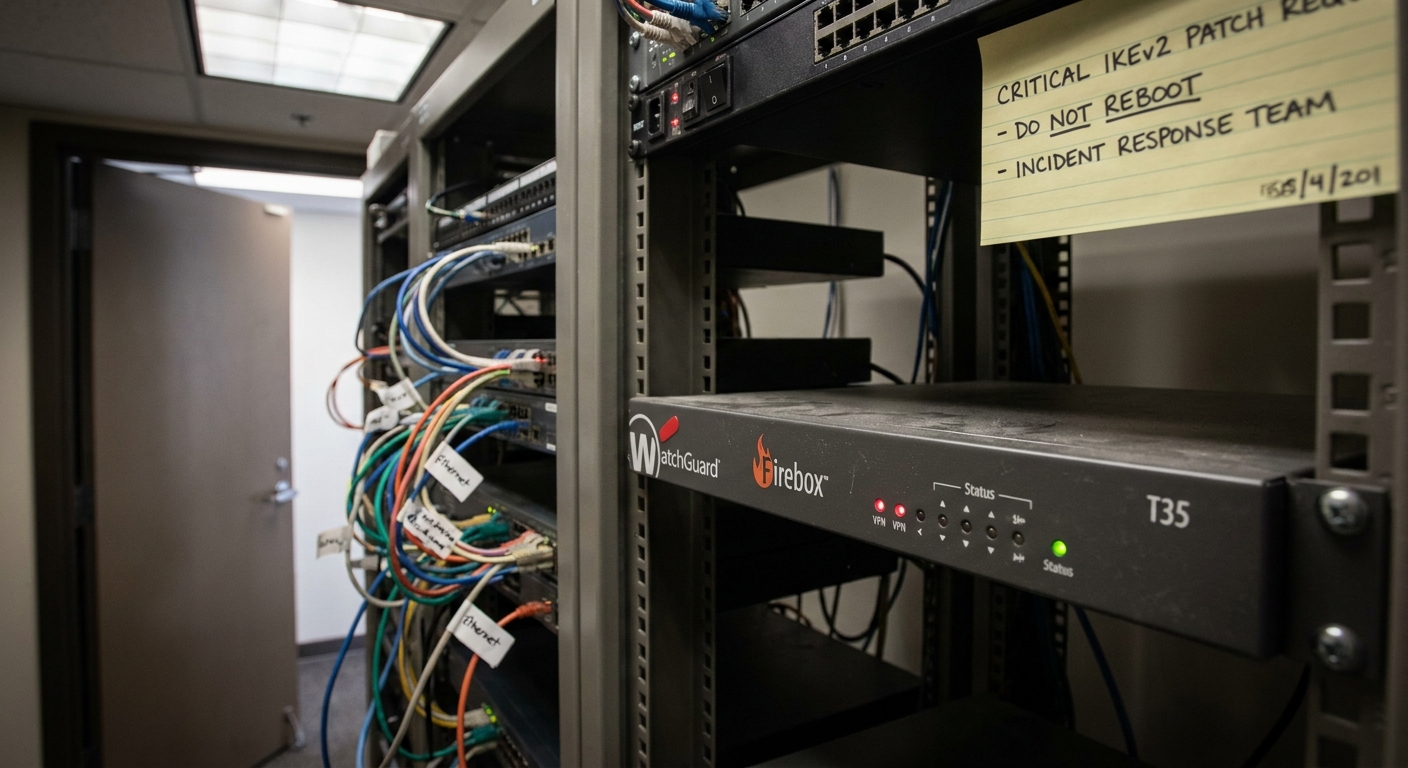
Here’s where the headache really kicks in for network admins: the legacy hardware. Specifically, the T15 and T35 Firebox models. These workhorses are still chugging along on the 12.5.x branch, but as of right now, there is no patch for CVE-2026-13368. If you have one of these in your rack and your IKEv2 VPN is enabled, you are effectively sitting on a target.
It gets worse for those still clinging to Fireware OS 11.x. These devices have sailed past their End-of-Life (EOL) date, which is industry-speak for "you’re on your own." No more security updates, no more patches, and no support. If you’re running this firmware, you aren’t just behind on maintenance; you’re operating in a permanent state of exposure.
Mitigation and Lifecycle Management
If you have modern hardware, the path forward is simple: update your firmware. WatchGuard has the files waiting for you on their official resource portal. Don’t wait for a maintenance window that might never come—get these patches applied to neutralize that LDAP race condition.
Beyond the immediate fire-fighting, you need to look at your broader infrastructure lifecycle. WatchGuard has already signaled that the Firebox M290 is hitting its End-of-Sale (EOS) status on August 1, 2026. It’s being phased out for the M295, with the M290 officially heading to the scrap heap on July 1, 2031.
Here is the reality check for your current operations:
- Immediate Action: If you’re on supported hardware, push Fireware OS 2026.2.1 or 12.12.1 to every internet-facing appliance immediately.
- Legacy Risk: If you’re stuck with T15 or T35 models on the 12.5.x branch, your best bet is to disable IKEv2 VPN services entirely until a fix arrives or you can retire the hardware.
- End-of-Life Policy: Firmware version 11.x is a dead end. If you’re still using it, you are permanently vulnerable. It’s time to upgrade.
- Hardware Procurement: Owners of M290 units can still renew services after the August 2026 EOS date, but don't be surprised if the logistics of replacing these units—including regional power cord requirements—add some friction to your procurement process.
The recurring nature of these IKEv2 flaws is a stark reminder that "set it and forget it" is a dangerous philosophy in network security. Regular firmware audits aren't just a best practice; they’re a necessity. As the industry shifts toward more resilient authentication frameworks, the persistence of these memory corruption bugs in VPN daemons remains a massive headache for everyone involved. Keep a close eye on the WatchGuard PSIRT portal—you’re going to need it.