DePIN Explained: How Bandwidth Mining is Shaping the Future of the Decentralized Internet
TL;DR
- ✓ DePIN leverages blockchain to build decentralized physical infrastructure through community-owned hardware.
- ✓ Bandwidth mining allows users to monetize idle internet connections by acting as network nodes.
- ✓ The shift to decentralized networks offers superior censorship resistance and global data authenticity.
- ✓ Token incentives transform passive internet consumers into active participants in a P2P economy.
If you’ve ever looked at your monthly internet bill and wondered why you’re paying for a connection that sits idle half the day, you’re not alone. Most of us treat our home Wi-Fi like a utility—like water or electricity. We pay the bill, we use it when we’re home, and we forget about it.
But what if your router could actually pay you back?
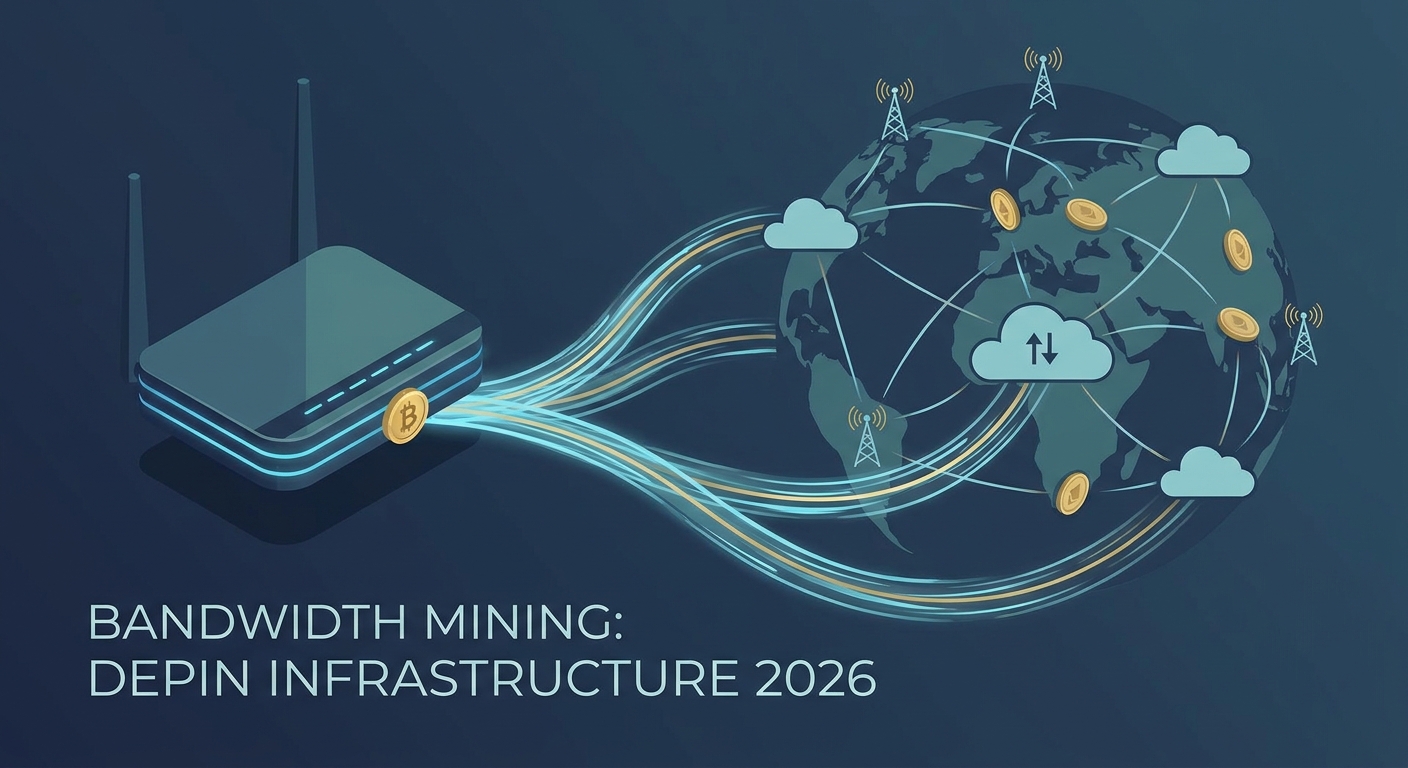
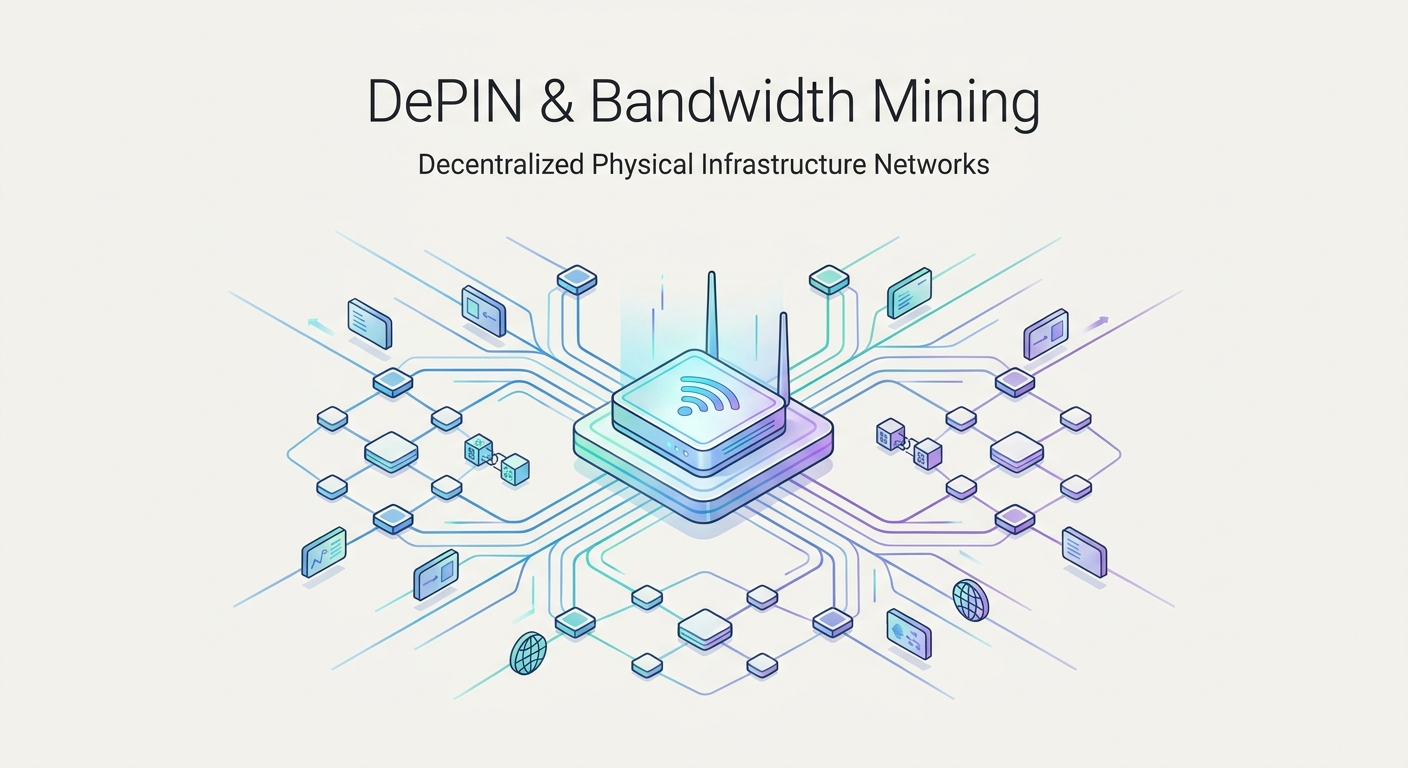
Bandwidth mining is the process of turning that "wasted" internet connection into a productive asset. By contributing your spare connectivity to a global, decentralized network, you stop being just another passive customer. You become a node operator. This is the heart of Decentralized Physical Infrastructure Networks (DePIN), and it’s quietly dismantling the old-school monopoly of big ISPs. Think of it as an Airbnb for Bandwidth. You have space (or in this case, speed); the network has a guest.
The Passive Internet is Over: Your Connection is a Goldmine
For decades, the internet has operated on a top-down, tiered model. Massive ISPs own the pipes, and you pay for the privilege of sitting at the end of them. You consume. You pay. You repeat.
But this era is hitting a wall.
As the world demands more transparency and censorship-resistant infrastructure, the industry is waking up to a simple truth: the most valuable resource isn’t hidden in some guarded, centralized data center. It’s sitting in your living room.
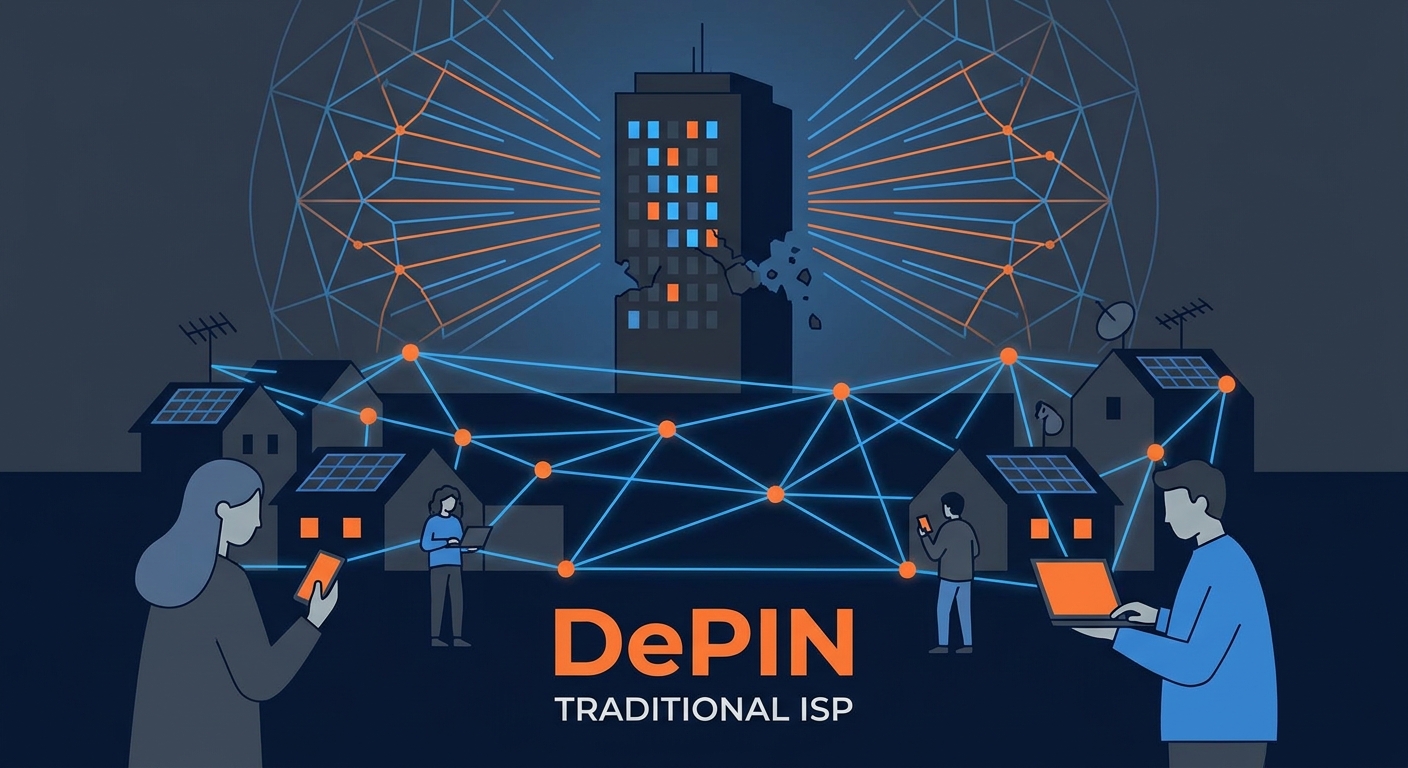
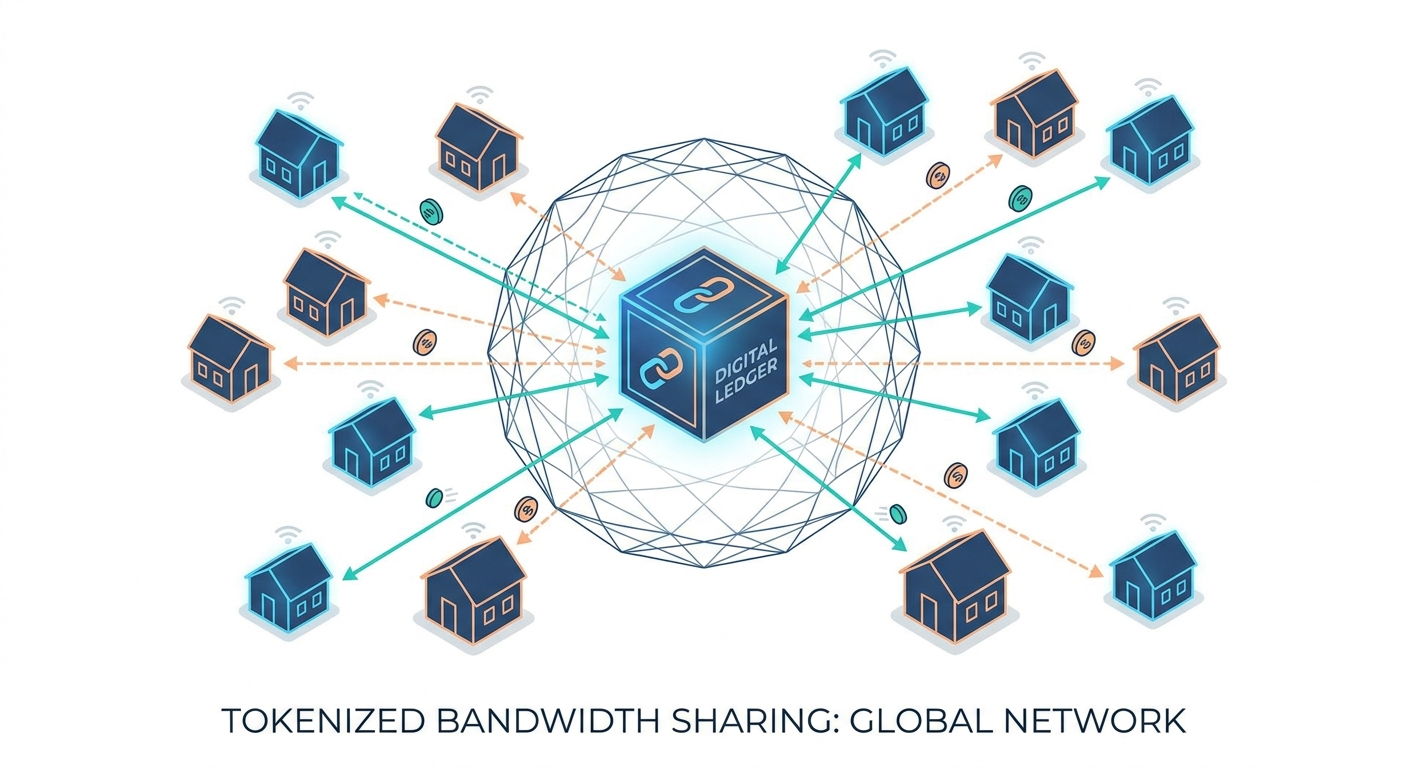
When you head to work or crawl into bed, your router stays on. That bandwidth is essentially burning a hole in your pocket. In the new decentralized paradigm, that same bandwidth becomes a commodity. By connecting your device to a DePIN protocol, you’re essentially acting as a micro-ISP. You’re no longer just a consumer; you’re the backbone. We are shifting from a rigid, corporate-controlled hierarchy to a bottom-up mesh where the user is the foundation.
What Exactly is DePIN, and Why Does it Matter in 2026?
DePIN stands for Decentralized Physical Infrastructure Networks. It sounds like a mouthful of tech-speak, but it’s actually quite simple: it’s just applying blockchain incentives to real-world hardware.
Instead of relying on a massive, faceless corporation to build cell towers, sensor grids, or relay points, DePIN rewards regular people for providing those resources themselves.
The sector has grown up fast. It’s moved past the "wild west" phase into a robust $20B+ market. In 2026, the focus is squarely on "Utility First." We aren’t just spinning up tokens for the sake of it. We’re talking about verifiable, high-demand services: AI data scraping, decentralized cloud storage, and browsing that actually survives regional filters. When a company needs to verify information globally without being blocked by local firewalls, they don't go to a centralized server. They go to a decentralized network, because decentralized nodes offer an authenticity that a data center simply can't fake.
How Does Bandwidth Mining Actually Work?
Bandwidth mining runs on a "Resource-Weighted" mechanism. The network isn't looking for just any connection; it wants the good stuff—reliable, fast, and consistent. Your rewards depend on a few key metrics:
- Uptime: Is your node actually online?
- Latency: How quickly can you relay data?
- IP Quality: Is your connection coming from a legitimate residential provider?
The real magic is the "Flywheel Effect." As more nodes join, the network becomes more reliable and geographically diverse. That reliability attracts enterprise clients—think AI labs or research firms—who are willing to pay for access to these high-quality residential paths. That demand drives more value, which pushes up the rewards, which attracts even more participants. It’s a self-sustaining loop.
Why are Residential IPs the "New Gold" for AI Companies?
Ever been hit with a CAPTCHA while trying to visit a website? That’s the internet telling you that you look suspicious.
Data-center IPs are the first to get flagged. Modern AI bots and security systems are incredibly smart; they know that real humans don't browse the web from an Amazon server rack in Virginia. They want to see traffic that looks like it’s coming from a home, a neighborhood, or a local coffee shop.
That’s why companies are desperate for residential proxies. As explained in this technical guide on residential proxies, an IP address assigned to a home connection is "authentic." When an AI company needs to train a model to see how a website appears in, say, rural Italy or suburban Tokyo, they need to look like a local. Your home connection provides that legitimacy. Since residential IPs are finite, they command a serious premium. Your bandwidth is no longer an expense—it’s an asset.
Privacy vs. Profit: Is Bandwidth Mining Safe?
Let’s address the elephant in the room: privacy. It’s natural to worry about what kind of traffic is flowing through your home network.
Modern DePIN protocols are built with a "zero-trust" architecture. Think of it as a secure, encrypted tunnel that passes through your house. You provide the pipe, but you aren't the one looking at the water. Advanced encryption and zero-knowledge proofs keep your personal traffic—your banking, your emails, your Netflix habits—completely isolated from the relay traffic. The protocol acts as a blind mediator. You can’t see the data, and the data can’t see you. It’s a clean, professional, automated hand-off.
How to Start Mining: Hardware and Set-up (2026 Edition)
Forget the multi-thousand-dollar GPU rigs. That was the speculative era. In 2026, efficiency is the only game in town.
The current gold standard is the "set-it-and-forget-it" model. You don't need a supercomputer. A Raspberry Pi, an idle home server, or even an old, low-power mini-PC will do just fine. These devices draw very little power, meaning your overhead is almost zero.
The goal isn't to brute-force a network; it's to provide consistent, high-quality uptime. Still worried about the tech side? Platforms like SquirrelVPN have stepped in to strip away the misery of command-line interfaces and manual port forwarding. They provide a dashboard that lets you plug in, monitor performance, and start contributing without needing a degree in computer science.
Freedom-Tech: How DePIN Combats Internet Censorship
Beyond the money, DePIN is "freedom-tech."
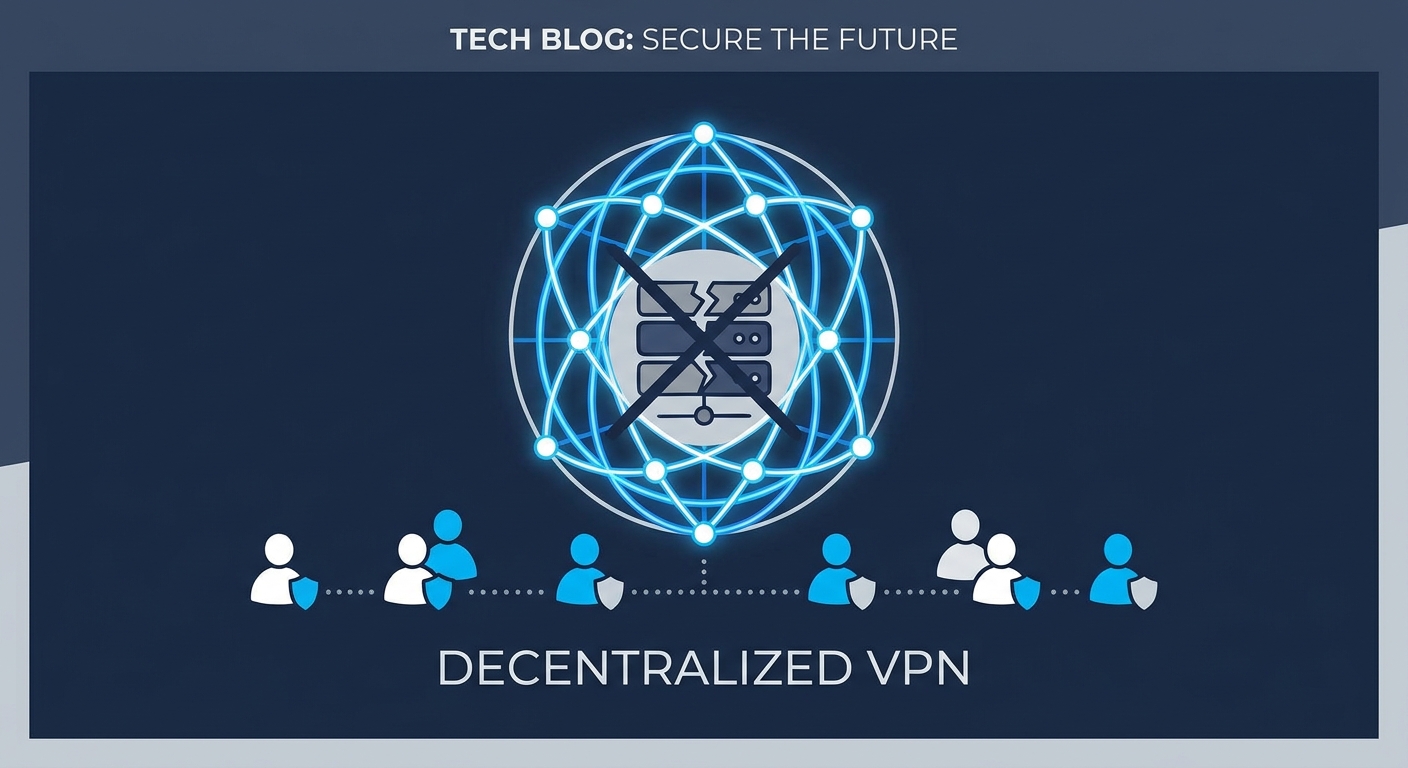
In parts of the world where the internet is heavily throttled or locked behind geo-blocks, decentralized VPNs (dVPNs) are a lifeline. Centralized VPNs are easy for authorities to coerce or shut down. But how do you shut down a network that has no headquarters?
This deep dive into P2P bandwidth marketplaces shows exactly how these networks bypass censorship by routing traffic through a global mesh of independent nodes. By participating, you aren't just earning tokens; you’re helping keep the internet open for someone who might otherwise be cut off from the world.
The Future of the Decentralized Internet
We are witnessing a changing of the guard. We are moving away from a web where a handful of corporations own the pipes and toward a web that is user-owned and user-operated.
Blockchain technology—specifically the high-speed, low-cost throughput seen in ecosystems like the Solana Foundation's ecosystem—has finally made it possible to handle the massive volume of micro-incentives these networks require.
The future of the internet is decentralized. It’s a web built by the people who use it, for the people who use it. By mining bandwidth today, you’re not just earning a little extra cash—you’re laying the foundation for a more resilient, private, and equitable digital world.
Frequently Asked Questions
Is bandwidth mining safe for my personal data?
Yes. Modern DePIN protocols utilize end-to-end encryption and zero-knowledge proofs. As a node operator, you act purely as a relay. The protocols are structured so that you have no visibility into the traffic passing through your node, and your own personal internet activity remains completely isolated and secure.
Do I need expensive hardware to start earning tokens?
Absolutely not. The 2026 standard for bandwidth mining prioritizes energy efficiency and reliability. You do not need expensive GPUs or specialized mining rigs; a standard Raspberry Pi, an old laptop, or a low-power home server is more than sufficient to run a node effectively.
Will my ISP block me for participating in a DePIN network?
Most residential ISPs allow peer-to-peer traffic as it is a standard part of internet usage. Because you are simply acting as a relay for encrypted data, it is rarely distinguishable from other high-bandwidth activities like streaming or gaming. However, you should always review your specific ISP’s terms of service to ensure you remain in compliance with their usage policies.
How much can I realistically earn from bandwidth mining?
Earnings are "Resource-Weighted," meaning they are directly proportional to the quality of your contribution. Factors like high uptime, low latency, and the quality of your residential IP address are the primary drivers of your rewards. While it isn't a "get rich quick" scheme, it is a consistent way to monetize a resource you are already paying for.
How does SquirrelVPN simplify this process for beginners?
SquirrelVPN provides a user-friendly dashboard that handles the complex technical configuration of node management. Instead of dealing with command-line interfaces and manual port forwarding, users can utilize the SquirrelVPN interface to monitor their node's performance, manage their rewards, and ensure their connection remains optimized for the network.