Understanding the Quantum Threat to RSA and ECC Cryptography
TL;DR
The Mechanics of RSA and ECC Vulnerability
Both RSA (Rivest-Shamir-Adleman) and Elliptic Curve Cryptography (ECC) are the backbone of modern online privacy news and secure web connections. RSA relies on the extreme difficulty of factoring large prime numbers, while ECC uses the Elliptic Curve Discrete Logarithm Problem (ECDLP). On classical hardware, a 256-bit ECC key provides security equivalent to a 3,072-bit RSA key because the Pollard’s rho algorithm would take billions of years to crack it.
However, this security is computationally asymmetric only for classical machines. Shor’s Algorithm, a quantum period-finding machine, can solve both integer factorization and discrete logarithms in polynomial time. While the quantum circuit for ECC is more complex per bit—requiring modular inversion and Toffoli gates—it requires far fewer total resources to break than RSA. Research from Webber et al. (2022) indicates that 256-bit ECC can be broken with approximately 2,330 logical qubits, whereas 2048-bit RSA requires 4,098 logical qubits.
!Quantum Threat 101: Why RSA and ECC Won't Last Image courtesy of Tekysinfo
Harvest Now, Decrypt Later (HNDL) Risk
The most immediate danger to VPN technology users is the "Harvest Now, Decrypt Later" strategy. Nation-state actors are currently intercepting and storing encrypted SSL/TLS sessions and VPN tunnels. While they cannot read this data today, the goal is to decrypt it once a Cryptographically Relevant Quantum Computer (CRQC) becomes available.
This poses a critical risk for data with long-term sensitivity, such as intellectual property, medical records, and government communications. If your data must remain confidential for ten years or more, the threat is active now. Organizations must evaluate their cryptographic exposure and transition to quantum-resistant protocols to protect against future decryption of today's traffic.
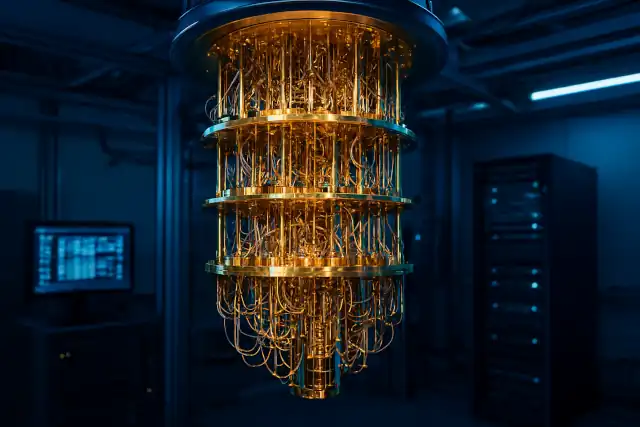
!Quantum Computer Hardware Image courtesy of PBX Science
New Standards: ML-KEM and ML-DSA
The transition away from RSA and ECC involves moving to Post-Quantum Cryptography (PQC). These are classical algorithms designed to be resistant to quantum attacks. The NIST Post-Quantum Cryptography project has finalized three main standards: FIPS 203 (ML-KEM), FIPS 204 (ML-DSA), and FIPS 205 (SLH-DSA).
ML-KEM (formerly Kyber) is a lattice-based mechanism used for general encryption and key encapsulation. It is the recommended default for TLS and VPN applications. ML-DSA (formerly Dilithium) serves as the standard for digital signatures. These new algorithms come with trade-offs; for instance, lattice-based schemes have much larger public keys and ciphertexts, which can increase handshake overhead by 20-35% compared to classical ECDH.
Implementing Crypto-Agility and Hybrid Deployments
For developers and system administrators, the move to PQC is not a simple patch. It requires Post-Quantum Cryptography Migration planning that focuses on crypto-agility. This means building systems where cryptographic algorithms are modular and can be swapped via configuration rather than code rewrites.
The current industry best practice is hybrid key exchange. By running ML-KEM and classical ECDH simultaneously, you ensure that the connection remains secure even if the new PQC algorithm is found to have a classical flaw. Open-source tools like the liboqs project provide reference implementations for these algorithms, allowing for security auditing and testing in production environments.
Stay ahead of the quantum curve with the latest cybersecurity trends and technical deep-dives. Explore our advanced security features and protect your digital footprint today at squirrelvpn.com.