
New Industry Report Reveals Critical Security Confidence Gap in European Remote Collaboration Infrastructure
TL;DR
The Great Illusion: Why European IT Leaders Are Overestimating Their Security
There is a dangerous disconnect brewing in the boardrooms and server rooms of Europe. A recent industry survey across the UK, France, and Germany has unmasked a "confidence gap" that should keep any CISO up at night. It’s a classic case of perception versus reality: while 84% of IT professionals claim they’re feeling good about their remote collaboration security, the actual data tells a much messier story.
We’ve all seen the shift. Remote work isn't a "trend" anymore; it’s the bedrock of modern business. But as we’ve rushed to keep teams connected, we’ve inadvertently built a digital house of cards. The state of secure collaboration report makes one thing painfully clear: just because your team can chat and share files doesn't mean your data is actually locked down.
The Confidence Paradox
Here’s the rub: 84% of IT leaders tell pollsters they’re confident in their setup. Yet, when you dig into the technical weeds, only 29% believe their current tools can actually handle highly sensitive communications.
How do you square that circle? You don't.
It suggests that many organizations are mistaking "operational uptime" for "security." They see that the Slack channels are buzzing and the Zoom calls are dropping in, so they assume the perimeter is secure. But the complexity of modern, hybrid work has outpaced the security protocols we’re still using. We’re living in a world where shadow IT—employees using whatever app is easiest to get the job done—has become the norm, and "uncontrolled external access" is no longer an edge case. It’s a persistent, daily threat.
Where the Wheels Fall Off: Access Management
The real friction isn't in the software itself; it’s in the messy, human reality of managing who gets to see what. Collaboration has become fluid, almost frantic. But that fluidity is the enemy of granular control.
The survey highlights some uncomfortable truths about how European organizations are handling their digital "keys to the kingdom":
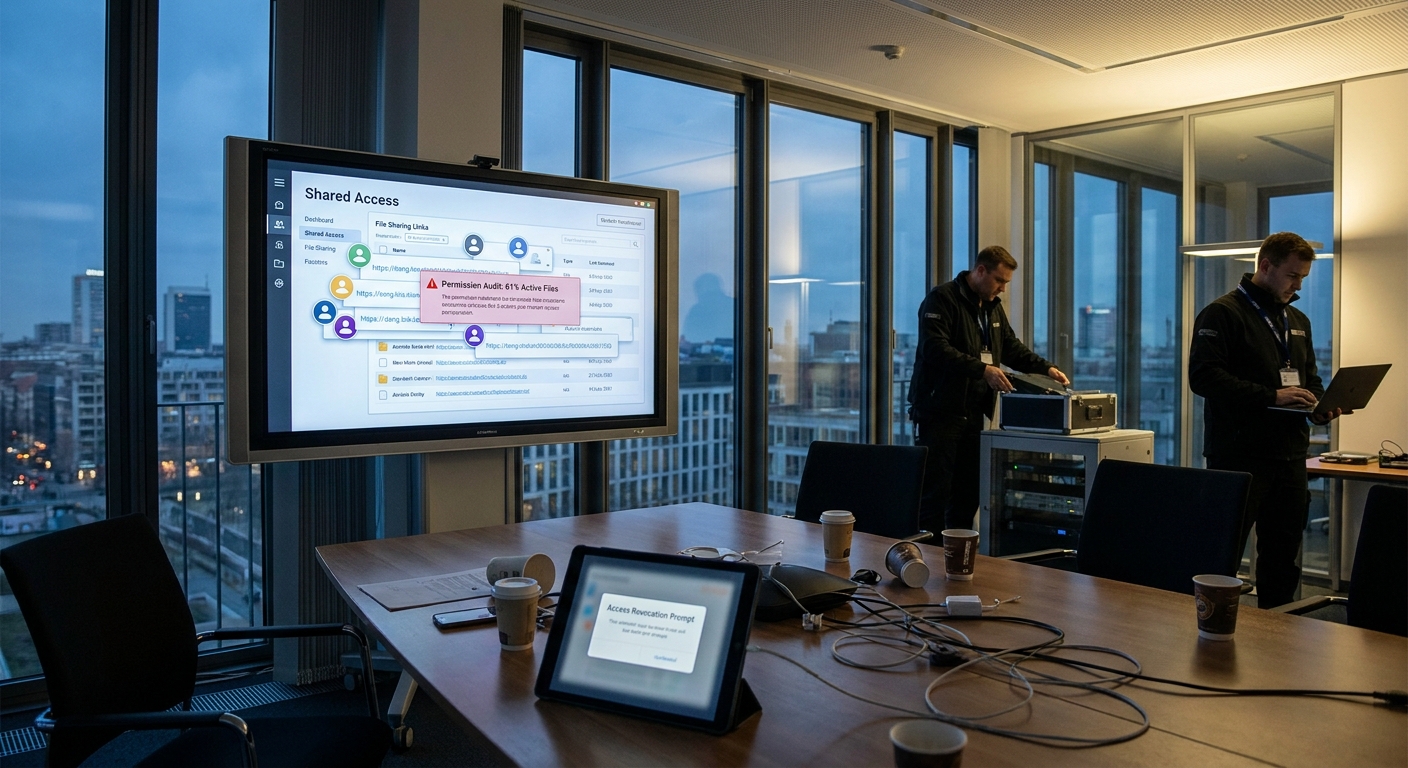
- The Zombie Access Problem: 61% of IT pros admit that access to shared files often lingers long after the project or the person has moved on. These are digital ghosts, sitting in your network, waiting to be exploited.
- The Visibility Void: 34% of IT teams are essentially flying blind. They struggle to track exactly who has eyes on sensitive files at any given moment.
- The Revocation Struggle: 19% of respondents find it a technical headache to actually pull back access once it’s been granted. If you can’t turn off the tap, you don't really have control over the water.
- The External Gap: Less than a third (28%) of organizations are using tools specifically built for secure external collaboration. The rest? They’re likely shoving sensitive data into standard platforms that weren't designed for high-stakes security.

Perception vs. Reality: A Dangerous Game
This gap, identified by industry analysts, is a symptom of a larger struggle. European businesses are trying to sprint toward digital transformation while carrying the heavy, rusted chains of legacy security. When IT departments feel "confident" despite clear evidence of permission creep, they aren't just being optimistic—they’re being negligent.
| Security Metric | The Reality Check |
|---|---|
| General Security Confidence | 84% feel good (perhaps too good) |
| Suitability for Sensitive Data | Only 29% are actually ready |
| File Access Lifecycle | 61% report "zombie" access |
| Tracking Capabilities | 34% are flying blind |
| Dedicated External Tools | Only 28% have the right gear |
The Cost of Convenience
When employees find that official channels are too slow or too clunky, they find a workaround. That’s shadow IT in a nutshell. And because most organizations haven't provided a secure, dedicated environment for external collaboration, that sensitive corporate data is inevitably leaking into platforms that lack the necessary encryption or access-control rigor.
Consider the 19% who struggle to revoke access. In an era of high turnover and constant third-party contracting, that’s a massive vulnerability. Every stale credential is an open door for a malicious actor. If you can’t clean up your digital footprint, you’re essentially leaving your front door unlocked and hoping no one notices.
The Path Forward
So, what’s the fix? It’s not just about buying another piece of software. It’s about a fundamental shift in how we evaluate our collaboration stacks.
We need to stop treating "collaboration" and "security" as two separate departments. Moving toward a "security-first" architecture—where external and internal communications are handled with equal rigor—isn't just a technical upgrade; it’s a necessary evolution.
Until IT leaders stop conflating "it works" with "it's secure," this gap will only widen. The high confidence expressed by many is likely just a byproduct of a successful platform rollout, not a sign of a robust security posture. Bridging the divide requires more than just new tools; it demands a ruthless, audit-heavy approach to how we manage the lifecycle of every single piece of digital access across the enterprise.
It’s time to stop guessing and start auditing. Your security is only as strong as your weakest, most forgotten permission.