10 Best dVPN Platforms for 2026: The Top Decentralized Networks for Censorship-Resistant Browsing
TL;DR
- ✓ Decentralized VPNs replace corporate trust with cryptographic verification for true online privacy.
- ✓ dVPN architecture acts as a global P2P network, effectively eliminating single points of failure.
- ✓ Residential IP usage makes dVPN traffic highly effective at bypassing modern state-level firewalls.
- ✓ Move beyond monthly subscriptions with pay-as-you-go bandwidth models found in Web3 networks.
Let’s be honest: the "no-logs" promise from big-name VPN providers has lost its luster. For years, we’ve handed our digital lives over to centralized corporations, trusting them to act as the gatekeepers of our privacy. But in 2026, that blind trust is a relic of the past. The industry has shifted toward something more reliable: cryptographic certainty.
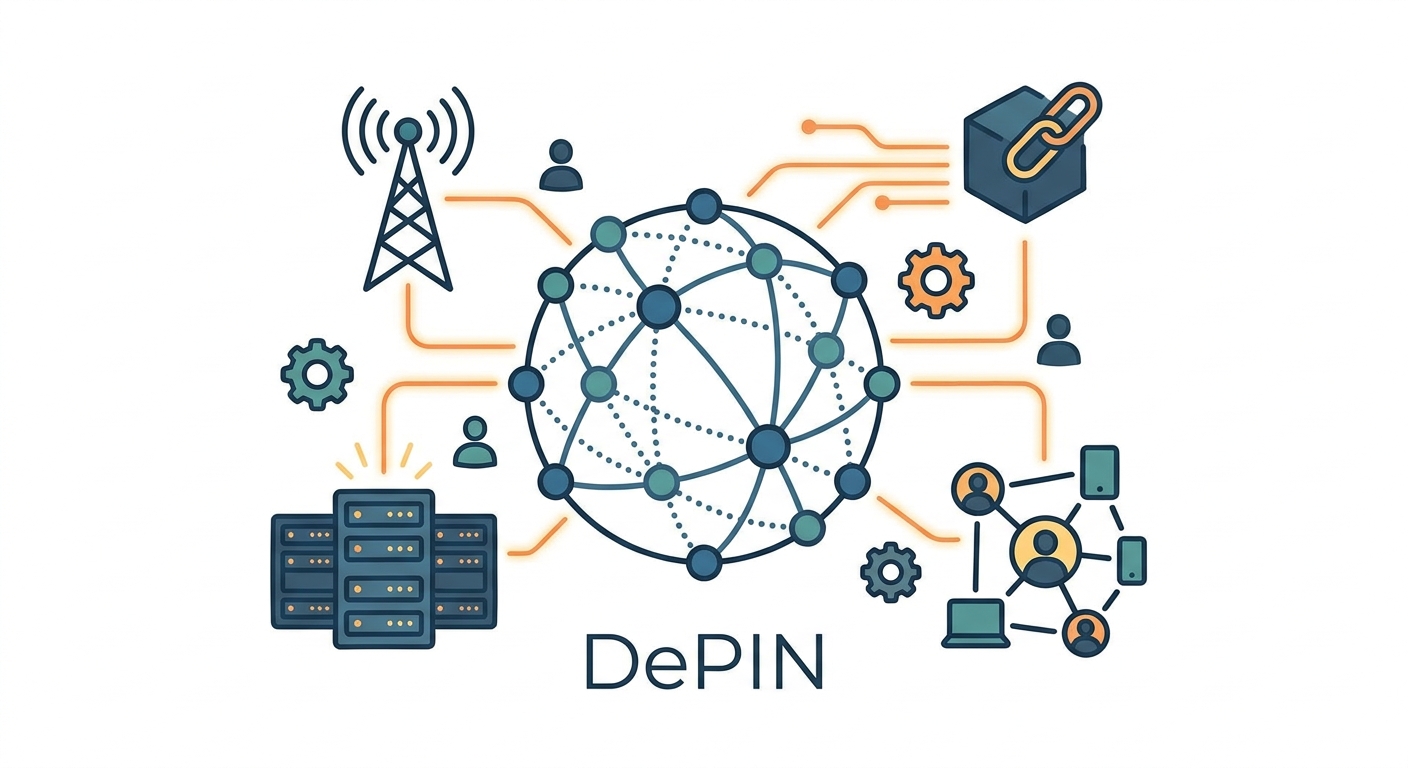
A decentralized VPN (dVPN) isn’t just another privacy app. It is a vital piece of DePIN (Decentralized Physical Infrastructure Network) architecture that cuts the middleman out of your internet connection entirely. If you’re tired of being a product, what is a dVPN? is the only question that matters right now.
How Do dVPNs Actually Work? (The "Airbnb for Bandwidth" Analogy)
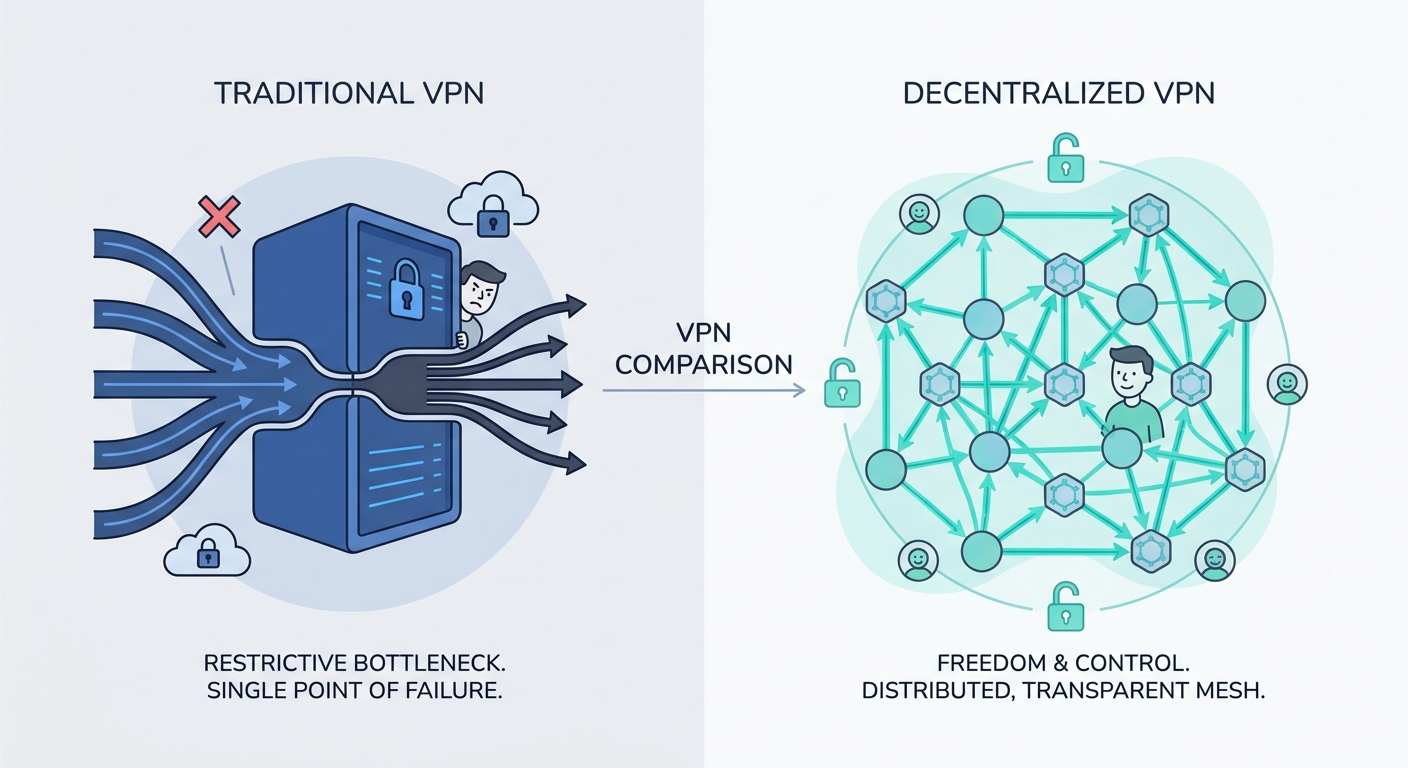
Think of a traditional VPN as a private toll road. You pay a company for exclusive access to their highway. If that company decides to cash in on your data or gets a knock on the door from a state agency, your "private" road suddenly has a camera at every exit.
A dVPN is different. It’s more like a global public transit network made of independent nodes. Instead of one central server, your traffic hops through a chain of peers scattered across the planet.
This P2P architecture means no single entity owns the pipe. By using blockchain privacy standards, these platforms swap shady corporate promises for smart contracts. The code verifies the connection, not a marketing team.
Why Transition to a dVPN in 2026?
The biggest push for this change? State-level firewalls. Traditional VPN data centers are sitting ducks; censors can identify and block their IP addresses in seconds. dVPNs use residential IP addresses, which makes your traffic look exactly like any other person surfing the web from their living room.
When you check an Internet Censorship Map, you realize these tools aren't just for privacy geeks anymore. They are essential utilities. Plus, the performance argument is dead. Modern routing protocols allow dVPNs to "hop" around network congestion, often leaving the sluggish, overloaded servers of mainstream VPN giants in the dust.
The "VPN vs. dVPN" Comparison Table
| Feature | Traditional VPN | dVPN |
|---|---|---|
| Infrastructure | Centralized Servers | Distributed P2P Nodes |
| Privacy Basis | Corporate Trust/Policy | Cryptographic Verification |
| Cost Model | Monthly Subscription | Pay-as-you-go / Bandwidth-based |
| IP Type | Data Center (Easily Blocked) | Residential (Censorship Resistant) |
The 10 Best dVPN Platforms for 2026
1. Orchid: The Pioneer of Probabilistic Nanopayments
Orchid is the gold standard for anyone who hates the "subscription trap." You pay only for what you use.
- The Vibe: Precision privacy for the professional.
- Pros: Granular cost control; zero central authority.
- Cons: You’ll need a basic grasp of crypto-wallets.
- Technical Verdict: Incredible node density; great for avoiding packet loss.
2. Sentinel: The Heavyweight in DePIN Integration
Sentinel is the engine room for a lot of today’s dVPN apps. Built on Cosmos, it’s lightning-fast and talks easily with other chains.
- The Vibe: Rugged, enterprise-grade infrastructure.
- Pros: Massive ecosystem; transparent open-source code.
- Cons: The interface can be a bit much for beginners.
- Technical Verdict: Industry-leading uptime.
3. Mysterium: The Global Residential IP Leader
Mysterium has effectively turned the world into a massive, decentralized exit node map. If you need to jump over a geo-block, this is the one.
- The Vibe: Peer-to-peer browsing made simple.
- Pros: Massive variety of exit nodes; sleek apps.
- Cons: Prices can fluctuate depending on demand.
- Technical Verdict: The king of streaming and bypassing regional restrictions.
4. Decentr: Privacy-First Browsing Integration
Decentr isn't just a VPN; it’s a browser-integrated ecosystem that actually pays you for your data footprint.
- The Vibe: An all-in-one Web3 privacy suite.
- Pros: Integrates perfectly with your daily browsing.
- Cons: Performance depends on the browser ecosystem.
- Technical Verdict: Ideal for "set it and forget it" users.
5. Tachyon Protocol: High-Speed Mesh Optimization
Tachyon doubles down on the "mesh," using Distributed Hash Tables (DHT) to find nodes in a heartbeat.
- The Vibe: The speed demon of the bunch.
- Pros: Minimal latency; highly scalable.
- Cons: A smaller node pool than the heavy hitters.
- Technical Verdict: The best pick for real-time apps and gaming.
6. VPN-X: The Mobile-First Contender
Built for the mobile-native generation, this platform prioritizes battery life and keeping your connection alive between towers.
- The Vibe: Privacy for the digital nomad.
- Pros: Feather-light; great UI.
- Cons: Desktop support is still catching up.
- Technical Verdict: Optimized for 5G/LTE handoffs.
7. DVPN-Nodes: For the "Hardcore" User
This is raw, protocol-level access for people who want to build their own custom privacy stacks via command line.
- The Vibe: For the tinkerer and the Linux die-hard.
- Pros: Total control over routing.
- Cons: High barrier to entry.
- Technical Verdict: The gold standard for auditing your own traffic.
8. InnerSpace: Focus on Stealth and Obfuscation
InnerSpace is a master of disguise. It makes it nearly impossible to detect that you’re using a VPN at all.
- The Vibe: A ghost in the machine.
- Pros: Elite obfuscation techniques.
- Cons: Heavier encryption means slightly slower speeds.
- Technical Verdict: The best defense against deep packet inspection.
9. BitVPN: The Multi-Chain Privacy Solution
BitVPN bridges different blockchain ecosystems, letting you pay with whatever token you happen to have in your wallet.
- The Vibe: The flexible, multi-chain hub.
- Pros: Great token compatibility.
- Cons: Can be confusing for wallet beginners.
- Technical Verdict: Rock-solid reliability and load balancing.
10. MeshNet: The Pure P2P Experience
MeshNet is the purest form of the movement. No service, no middleman—just you connecting directly to peers.
- The Vibe: True digital sovereignty.
- Pros: No fees; total freedom.
- Cons: Requires some manual setup.
- Technical Verdict: The most secure, though least convenient, way to browse.
Can You Earn While You Surf? (The DePIN Revolution)
The best part of the DePIN explained model is that you aren't just a customer anymore—you’re a provider. If you have extra bandwidth, you can turn it into a node, contribute to the network, and earn rewards. If you’re ready to stop just paying for privacy and start participating, you can learn how to set up your first dVPN node and turn your connection into an asset. It turns a monthly bill into a self-sustaining ecosystem.
Performance Benchmarks: Latency vs. Node Count
As these networks grow, the math speaks for itself: more nodes equals a faster, more stable experience for everyone.
Frequently Asked Questions
Are dVPNs legal to use?
Yes. They are just peer-to-peer networking tools. That said, they don't grant you immunity from local laws, so always be aware of your specific regional regulations.
Do I need to know how to code to use a dVPN?
Not anymore. While the tech is complex, platforms like Mysterium and Orchid offer consumer-friendly apps that work just like the VPN you’re likely using right now.
Is a dVPN faster than a traditional VPN?
Often, yes. Because you can connect to a node that is physically closer to your target—rather than bouncing through a distant, crowded central server—the latency is often much lower.
Can I earn money while using a dVPN?
Absolutely. By running a node, you lease your idle bandwidth for tokens. It’s a great way to offset the cost of your browsing.
How do dVPNs handle residential IP rotation?
They do it automatically. As nodes join and leave the mesh, your traffic cycles through different residential IPs. It’s a game of "whack-a-mole" that firewalls simply cannot win.